Kelsey and Marissa join Steve and Keith to discuss the 10-year anniversary of a very traumatic incident involving Mario Party. Kelsey lies and Keith, as always, tells the truth.






Kelsey and Marissa join Steve and Keith to discuss the 10-year anniversary of a very traumatic incident involving Mario Party. Kelsey lies and Keith, as always, tells the truth.
Danielle interviews Keith about gametimebro. Keith praises Whiplash while Danielle vents about the grocery store. Keep in mind that this episode was recorded a few weeks ago.
During the lead-up to the 87th Academy Awards, most Oscar prognosticators agreed that the contest for Best Picture had become a bout between two heavyweights. In one corner was Boyhood, a Richard Linklater film twelve years in the making that depicted a young man’s journey from age six to the first day of college. In the other was Birdman, a movie from Alejandro Iñárritu about a washed up movie star trying to hack out a career resurrection as a playwright and stage actor. Both pictures were strong contenders backed by staunch advocates.
Of course, as so often is the case in any popularity contest, many of the biggest proponents of each film turned into the biggest critics of the other. Boyhood detractors complained that although a twelve-year production timeframe was an impressive feat, it didn’t necessarily make for an impressive final product. They also belittled the script for being overly long and underdeveloped, largely improvised on a year-by-year basis. Meanwhile, Birdman opponents dismissed the film’s seamless aesthetic, designed to look like one long take, as more of a technical gimmick than an artistic endeavor. Moreover, many rolled their eyes at the prospect of the Academy of Motion Picture Arts and Sciences, comprised of several old white men who ascribe relevance within the acting and writing industries, being won over by a fictional old white man struggling for relevance in the acting and writing industries. The hot takes continued long after the Oscars, too. After Birdman won Best Picture, several editorials claimed that the Academy had just made its biggest mistake in decades, arguing that Boyhood will long be held up as a far more deserving candidate. On the other hand, gametimebro’s own editor-in-chief Keith boldly claimed in a recent podcast that Boyhood winning Best Picture would have been the single worst Oscars travesty of all time.
Buried by all of the divisive commentary, however, is an important development. In either case, whether Birdman or Boyhood had won Best Picture, the Academy was set to reward a truly unique and original movie with its highest honor. This is something the Academy almost never does anymore.
News Flash: Stevie sucks at Halo.

Steve explains Earthbound’s final boss. Stevie and Keith have their minds blown.

Ever since its in-engine reveal trailer at E3 2013, The Order: 1886, a Sony exclusive developed by Ready at Dawn and Santa Monica Studios, has been looked to by gamers to justify their purchase of the PlayStation 4. With its unprecedented graphics and cinematic feel, The Order appeared to be the first game to deliver a uniquely next-gen experience. As a result, the game was burdened with some lofty expectations that it unfortunately fails to meet. Though it looks amazing and has its share of fun moments, The Order: 1886 focuses too heavily on attempting to approximate a movie and ultimately fails thanks to disjointed, derivative gameplay that is never quite woven together to create a cohesive narrative.

Steve, Stevie, Keith, and Danielle cope with the end of Parks and Rec by sending some Fronks for a ride.

Steve, Stevie, and Keith discuss the state of TV Comedies now that Parks and Recreation is off the air.

Stevie, Steve, and Keith decide to fling themselves against some buildings in lieu of CFL fandom. Warning: the audio of this video is worthy of CFL in that it’s super, super shitty.
Steve, Stevie, and Keith discuss Sega Genesis, ClayFighter, Space Station Silicon Valley, TimeSplitters: Rewind, and a fate worse than death: the CFL.
Is Bowser a viable space pet? Is R.O.B. a viable space doctor? No fucking clue, but here’s us playing Smash.

Steve, Stevie, Mikey, and Keith debate what they would do with a meteor crashing towards the Earth. Mikey never mentions bukkake. Oh, and they talk games.
Only one turtle can survive in this post-apocalyptic world in which the Statue of Liberty has become sentient and moved herself to the center of the country!

Now that the Resident Evil series has made the jump to the eighth generation of video game consoles with the episodically-released Resident Evil: Revelations 2, it’s sadly hard to have high expectations. After a strong run of main franchise games with Resident Evil 4, 5, and Revelations between 2004 and 2011, Capcom has run into a cold streak, with 2012’s terrible Operation: Raccoon City followed up months later by the only slightly improved Resident Evil 6 (for those wondering at home, there’s essentially no logic to what constitutes a spin-off and what’s a main numbered game in the Resident Evil universe). But Revelations 2 does have a bit of a reputation to live up to; the original Revelations was one of the strongest games in the early days of the Nintendo 3DS, a well-paced blend of old-school survival horror the series cut its teeth on and the more fast-paced action of the more recent installments. If Resident Evil: Revelations 2 could build off the strengths of its predecessor, it might make fans forget about Capcom’s recent failures. Unfortunately, while the recently-released first chapter makes for a fun few hours, it doesn’t come close to reaching the heights of the best of the series.

Danielle discusses which celebrities she wants to befriend and which celebrities she wants to date. Keith remains unfazed. SNL turns 40 and Stevie does not.

Last month, a flurry of reports emerged alleging that Nintendo and Netflix were in the process of developing a live-action series based on The Legend of Zelda. And by all accounts, they’re really going for something big; the phrase “Game of Thrones for a family audience” was thrown around for good measure. Lots of people seem pretty excited about the rumored adaptation, and it’s easy to see why. In addition to boasting one of the deepest and richest universes in all of gaming, The Legend of Zelda is well known and easily recognized by even the most casual of gamers. Twenty-five years and seventeen games’ worth of intellectual property would provide showrunners with an immense array of pre-imagined kingdoms, characters, and potential plot arcs. Meanwhile, the franchise’s loose and fractured timeline almost seems tailor-made to allow creators the freedom to craft their own original stories rather than attempting faithful adaptations of any games in particular.
Still, despite all the elements of Zelda that point toward a TV series being a great idea, there’s at least one enormous obstacle for the concept, right at the center of everything else: Link.

Steve, Stevie and Keith learn the hard way that they can’t bro-op Four Swords Aventures.
Watch Steve and Stevie bro-op some Hyrule Warriors. Steve learns the hard lesson most of us learned back in 2006: Midna is a poor man’s Navi.

Ever since its initial release on the Nintendo 64 in 2000, The Legend of Zelda: Majora’s Mask has existed in The Legend of Zelda: Ocarina of Time’s shadow. It holds the distinction of not only being one of the few direct sequels in the franchise but also the direct sequel to what many believe is the best Zelda game of all time. What’s more, it was saddled with an impossibly short development cycle of just over one year, necessitating the re-use of the Ocarina of Time engine as well as many of its assets. With the uncharacteristically short turnaround between games, the memory of Ocarina of Time was fresh in the mind of gamers as they embarked on their next adventure with Link. Because of that, it was nearly impossible to evaluate Majora’s Mask without making direct comparisons to Ocarina of Time.
Perhaps that is why Nintendo did so much to differentiate the two titles in all the areas they could. Majora’s Mask was darker and stranger with a much heavier emphasis on side quests. Unfortunately for Nintendo, it seemed gamers didn’t want a differentiated game; though it received similar critical acclaim, Majora’s Mask could never match the commercial success of its predecessor. By comparison, it was a bit of a failure. Well, it’s now been seventeen years since the original release of Ocarina of Time and Majora’s Mask has finally been given opportunity to come out of the shadows and be evaluated on its own merits. The Legend of Zelda: Majora’s Mask 3D remake for the Nintendo 3DS delivers in spades as developer Grezzo has made all the right tweaks to make a fifteen-year-old game relevant and accessible in today’s gaming landscape. This is absolutely the best version of the game and also one of the very best reasons to own a 3DS.

After spending over 2 hours talking about Zelda, Steve, Sween and Keith decide to let off some Zelda-themed steam in gametimebro’s first episode of After3rd! Watch Sween make one of the biggest mistakes of his life…

Listen to our Zeldcast as gametimebro kicks off Zelda Week! Steve and Keith are joined by Sween and Webber to discuss The Legend of Zelda franchise.
Stevie, J and Keith discuss Project Ukulele, a possible Nintendo Theme Park and fun ways to drown Webber!

Mikey, J, Stevie and Keith discuss their gaming past, present and future.
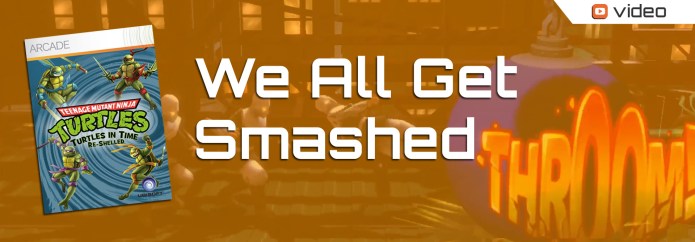
Steve, Stevie and Keith bring out their inner turtle as they see if this “re-shelled” classic lives up to the nostalgia.

While entries in the Castlevania series had appeared on Nintendo handhelds before the 2001 release of Circle of the Moon, the results varied in quality and rarely lived up to their console brethren. Hardware limitations on the Game Boy resulted in short games with poor graphics and limited save capabilities. All of that changed with Castlevania: Circle of the Moon, which launched alongside Nintendo’s new Game Boy Advance, ushering in an era of high-quality handheld Castlevania games that continued throughout the GBA’s run and then through the Nintendo DS as well. While I’ve played and loved the two games that followed this on the Game Boy Advance – 2002’s Harmony of Dissonance and 2003’s Aria of Sorrow – it was time to go back and play Circle of the Moon to see if it could hold up against its successors.

Danielle and Keith are joined by Stevie to discuss the Super Bowl, Game of Thrones, television shows and movies based on games and more.

Steve and Keith are joined by Tim on 3rd Party Support. They discuss their impending March Madness Tournament as well as tournaments of the past. Sins are revisited, but are they forgiven?

Keith bros down with the sequel to one of his favorite games of all time.

“When you play the Game of Thrones, you win or you die.”
– Cersei Lannister
Okay. That’s a bit dramatic. You won’t die if you play this game, but you might find yourself making decisions that cost a character his life. When it was announced that Telltale Games would be tackling the Game of Thrones Universe I was thrilled. In many ways, it felt like a match made in heaven. After all, HBO’s Game of Thrones is a show that delves deep into relationships and how they can be forever altered by a slip of the tongue or a strategic misstep. To me, there’s no better studio to translate that dynamic into a game. Does Game of Thrones Episode One: Iron From Ice live up to my lofty expectations? Yes, for the most part, but it’s held back by a few nagging issues that prevent it from realizing its full potential.

The First Episode! Today we talk about the importance of creative outlets, Keith and Danielle’s bet, men’s rights, Lena Dunham and more.

J, Stevie and Keith Bro Down with Super Smash Bros.
Listen to 3rd Party Support 00 as Steve and I stumble through our first attempt at a podcast!
Follow us: Twitter | Instagram | Twitch | YouTube
iTunes: Subject to Change | Steve and Kevin Watch Anime | GTBS
Google Podcasts: Subject to Change | Steve and Kevin Watch Anime | GTBS
Email us: gametimebro@gametimebro.com
We’ll just leave this here.
 gametimebro.com